

Before a trip to Dubai, a lot of people read horror stories about tourists almost getting arrested for wearing shorts, or women being turned away at mall entrances for showing their shoulders. Then they arrive – and see girls in tight dresses walking through those same malls, and people in swimsuits on the beach. The gap between expectation and reality is enormous, and it's easy to get lost in it.
The truth is somewhere in the middle. Dubai is a Muslim country with rules that genuinely apply – and at the same time, it's the most liberal emirate in the UAE, one that's been hosting millions of tourists a year for decades. There's no single rigid dress code here. There are zones and contexts, and each one runs by its own rules. The system isn't hard to navigate once you understand the logic, rather than just trying to memorize a list of prohibitions.
The core principle: the place sets the rules
Dubai works like several parallel cities stacked inside one. A beach resort with bikinis and a hotel nightclub exist side by side with ancient neighborhoods, mosques, and government offices – and each of those spaces has its own norm. A tourist moving between them needs to understand one thing: the rule doesn't follow you. It's tied to the location.
Beach and pool: maximum freedom
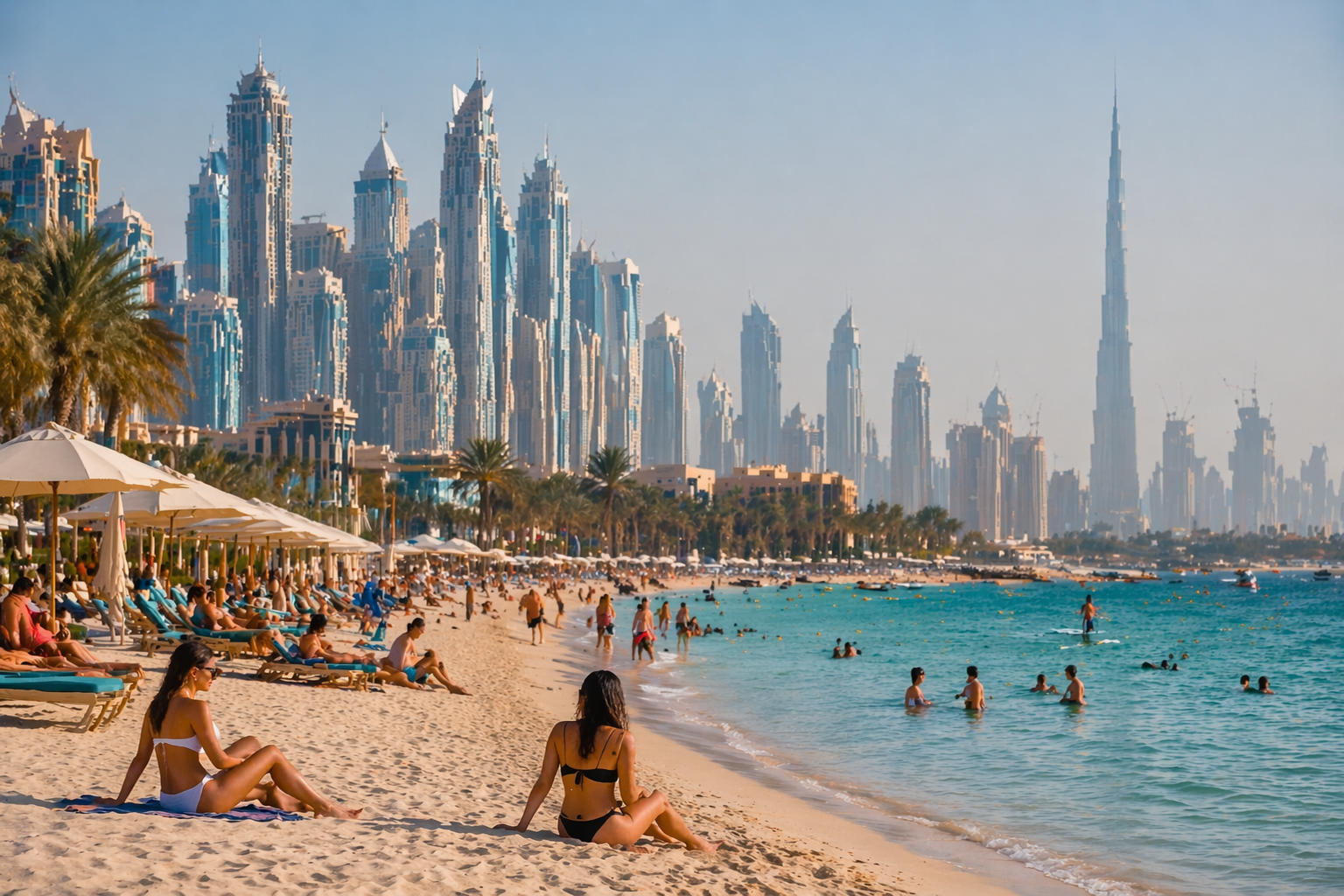
Beaches and hotel grounds are the zones of greatest freedom in Dubai. International tourist norms apply here, not Islamic ones.
Swimsuits, bikinis, swim trunks – all of it is allowed and completely normal. No one is going to say anything to a woman in a two-piece or a man in Speedos. Sunbathing and swimming are fair game, whether you're at a private hotel beach or a public city beach like Jumeirah Beach, Kite Beach, or La Mer.
Two hard rules, that hold even here.
Going topless is strictly prohibited. Not "frowned upon," not "better to avoid" – prohibited, with real consequences including fines and a potential police visit. This applies to both beaches and pools. Nudism is completely off the table.
Leaving the beach area in a swimsuit is not allowed. The moment you're heading from the beach to a café, a shop, or the street, you need to cover up. A cover-up, sarong, or shorts and a t-shirt over your swimsuit – that's the minimum. This rule extends to the waterfront promenade, technically, walking along the shoreline in just a swimsuit is a violation.
Shopping malls: the shoulders-and-knees rule
The Dubai Mall, Mall of the Emirates, Ibn Battuta Mall – these enormous, gleaming, heavily air-conditioned spaces are where most tourists spend a big chunk of their time. They're also where dress code misunderstandings happen most often.
There's no official dress code posted at the door of Dubai's malls. But there is a firm unwritten standard, that security actually enforces, shoulders and knees covered. That means no spaghetti-strap tops, no exposed midriffs, no miniskirts, no very short shorts. Leggings without a long tunic or shirt over them can also draw a warning.
The one practical tip that never fails, carry a light cardigan, shawl, or scarf. Plus, the air conditioning in Dubai's malls runs so aggressively cold that you'll want, that layer within twenty minutes anyway, for purely climate-related reasons.
Streets zone and public places: the middle ground
Dubai's streets are slightly more relaxed than its malls – but the same logic applies. Tourist-heavy areas like Downtown, Dubai Marina, JBR, and Palm Jumeirah are used to all kinds of people and tend to look the other way on a lot. But the farther you get from the tourist zones, the more it matters to dress in line with the general norm.
For women, the go-to for city walks is light pants or a knee-length skirt, with a t-shirt or short-sleeve top. Dresses and sundresses work well if the length hits below the knee and, of course, the shoulders are covered.
For men, shorts on the street are fine – ideally at or just above the knee. Sleeveless tank tops are better saved for the beach.
The metro has its own separate rules. No eating or drinking. The first car is reserved for women and children, men are not supposed to enter it, even if it's empty. The dress standard on the metro mirrors what's expected in the malls.
Restaurants and cafes: depends on the format
Dubai offers everything from street shawarma for five dirhams to Michelin-starred tasting menus. The dress expectations vary just as widely.
At casual cafés and mid-range spots, the same modest everyday outfit that works in the malls works here. The main thing: don't show up straight from the beach. Change out of your swimwear before sitting down.
At upscale restaurants and trendy venues, the standard is smart casual or even business casual. For men, that means trousers and a collared shirt – not a t-shirt – and closed-toe shoes. Showing up to a nice restaurant in shorts can mean getting turned away at the door, and that's entirely within the venue's rights. For women, a dress or trousers with a blouse. Bare shoulders at an evening venue are fine if the rest of the outfit is put-together.
Bars and restaurants on hotel grounds run noticeably looser, these spaces operate essentially as international zones, and what goes in a comparable venue anywhere else in the world generally goes here too.
Nightclubs: their own vibe, their own rules
Dubai has a real nightlife scene – clubs, bars, and lounges run late, and alcohol is served at licensed venues on hotel grounds. On the clothing front, this is where the dial shifts toward more freedom: evening looks, open-back dresses, heels – all of it fits in and is expected.
The catch here is about venue standards, not local law: many of Dubai's higher-end clubs enforce their own strict dress code – not "modest," but the opposite, "dressed up." A guy in shorts and sneakers might get stopped at the door – not because he's breaking any UAE rule, but because the venue has a look it maintains. The same dynamic you'd run into at a stylish club in New York or London.
Mosques: the strictest requirements
Visiting a mosque is a different context entirely, and dress rules here are observed as strictly as they get. "Recommended" doesn't apply – these are requirements.
For women, arms covered to the wrist, legs covered to the ankle, shoulders covered. And the head – without exception. A scarf or headcovering over the hair is mandatory. Without it, you simply will not be let in.
For men, full-length pants, a shirt with sleeves. Shorts and tank tops are not permitted.
The good news: most of Dubai's major mosques that are open to tourists – Jumeirah Mosque in particular – provide clothing right at the entrance. Women are given abayas and head scarves, men are given long shirts. It's free, and it removes the need to plan your outfit around the visit in advance. Just make sure you're not walking over in nothing but a swimsuit.
Remove your shoes before entering. Inside, keep your voice low, don't disturb anyone praying, and don't photograph people without their permission.

Government buildings: strict, no exceptions
Visa centers, police stations, courthouses, hospitals – anywhere you're dealing with government institutions, your clothing should be as covered and neutral as possible. Bare shoulders, low necklines, short skirts – none of that is appropriate here.
This rule rarely gets mentioned in travel guides, but it's applied more consistently here than almost anywhere else. Having a problem with your documents while dressed for the beach is not a combination you want.
Ramadan: the dress code tightens
Ramadan – the Islamic holy month of fasting – falls on different dates each year on the Gregorian calendar. If your trip overlaps with it, dress expectations get a bit stricter, even in tourist-heavy areas.
A few years back, restrictions during Ramadan were severe, no eating or drinking in public, including water, nightclubs shut down; fines for violations hit $200 or more. The rules for tourists have eased significantly since then – restaurants are open, nightlife continues (though some venues close earlier), and eating and drinking in tourist districts is handled with more flexibility.
But treating the dress code with more care during Ramadan matters. Dressing more modestly isn't a hard requirement, but it's a sign of respect toward the people around you who are fasting. Revealing outfits and conspicuous skin feel particularly out of place during this period, even in contexts where they'd normally pass without comment.
What you can never wear, anywhere
Some categories of clothing are off-limits regardless of where you are or what you're doing.
Clothing with offensive, provocative, or religious imagery or slogans. A t-shirt with anti-Islamic symbolism or a caricature of religious figures isn't just a dress code violation – it's a criminal offense, not an administrative one.
Anything that mimics UAE military or police uniforms. Even camouflage shorts are better left at home.
Clothing associated with drug use or drug promotion – also prohibited.
Sheer fabrics through which underwear or skin is clearly visible will draw a warning or a fine in any public setting.
What to pack: the practical list
Once you understand the logic of Dubai's dress code, packing isn't complicated. Here's what you actually need:
A lightweight cardigan or wrap – the universal fix for malls, transportation, and any unexpected situation. Cotton or linen are ideal for the climate.
A scarf or head covering – for mosques and as a backup. Takes up essentially no space.
Pants or a long skirt – for walks through older neighborhoods, markets, and any government offices.
Closed-toe shoes – useful for mosques and nicer restaurants. Heels are easy to manage inside a mall, but for walking the city, sneakers or flats are the smarter call.
Swimsuit plus cover-up or sarong – the beach kit. The cover-up is non-negotiable the moment you step off the sand.
An evening outfit – if you're planning restaurants or clubs. For women, a knee-length-or-longer dress or a polished suit. For men, trousers and a collared shirt.
The biggest misconception about Dubai and clothes
Most people assume that Dubai's dress code is about restrictions and limiting freedom. It's actually about context and respect.
Dubai is one of the few cities in the world where a five-star beach resort with guests in barely-there swimwear exists a few blocks from a conservative neighborhood with centuries of tradition. Locals have long since adapted to tourists, to diversity, to the sight of a woman in an abaya walking next to a woman in a minidress. There's no conflict here – there's zoning.


