A must-visit places for every tourist
Most tourists come to Dubai for the skyscrapers, the water parks, and the malls. They photograph the Burj Khalifa, pick up perfume at duty-free, and fly home convinced they saw the city. They didn't. The real Dubai hides somewhere else entirely – in the narrow, dusty alleyways of the Al Fahidi neighborhood, in the smell of cinnamon and cardamom drifting through the Spice Souk, in the creak of wooden abra boats on the water of Dubai Creek. That's where you should go first. And that's exactly where the package-tour crowd almost never ends up.
The city that almost disappeared
In the 1950s, Dubai was a small fishing village of roughly 20,000 people. The main income came from pearl diving and trade along the Gulf. No oil wealth, no air conditioning, no shopping centers. Just a creek, boats, mud-brick houses with wind towers.
In seventy years, the city transformed beyond recognition. But one small pocket of old Dubai survived – the Al Fahidi neighborhood, also known by its historical name, Al Bastakiya. It sits on the bank of Dubai Creek, right at the water's edge, and what separates it from the rest of the city isn't a fence – it's a different era. Step off a busy street into its lanes, and the noise of the metropolis simply stops.
What it is and where it came from
Al Fahidi is a restored historical district made up of several dozen old houses. Most of them were once the homes of wealthy Iranian merchants who arrived here from the Persian city of Bastak in the late 19th and early 20th centuries. That's why the neighborhood was long known as Al Bastakiya – named after the Iranian town its first residents came from.
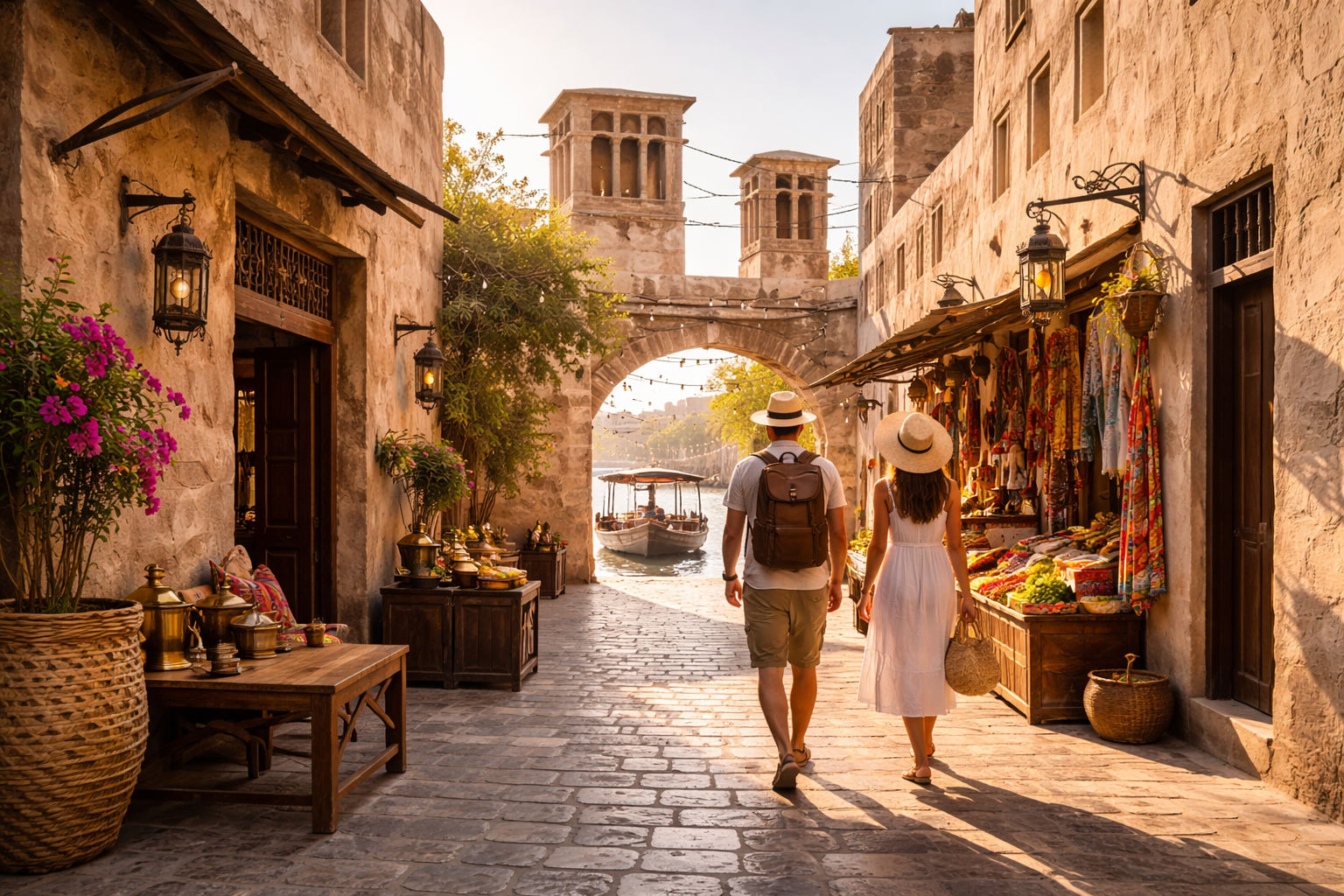
The architecture is unlike anything else in the city. The houses are built from coral limestone and clay – materials that hold coolness well in the heat. The exterior walls are austere, almost fortress-like: no ornamentation, no extra detail. But the interior courtyards are richly designed, with carved wooden arches, fountains, and shade that makes the scorching heat bearable.
The neighborhood's defining architectural feature is the wind towers, known as barjeel. These are rectangular structures rising above the rooftops that catch the faintest breeze and funnel it down into the living spaces below. Air conditioning, invented centuries before electricity. Al Fahidi is one of the very few places on the Arabian side of the Persian Gulf where these towers survive in their original form – not reconstructed for tourists, but genuinely intact.
In the 1990s, the neighborhood was slated for demolition. The land was too valuable, the buildings too fragile. It was saved by the personal intervention of Sheikh Mohammed, who ordered a full restoration and directed that the area be turned into a cultural center. Today Al Fahidi is a candidate for UNESCO World Heritage status – which is probably the best single measure of what it's worth.
What to see inside the neighborhood
Al Fahidi Fort and the Dubai Museum. The fort was built in 1878, making it the oldest surviving building in the city. It's a classic defensive structure: a rectangular layout, two watchtowers, thick walls of coral and clay, massive gates. In its time it served as the ruling sheikh's residence, then as a prison, and since the 1970s it's housed the Dubai Museum. Inside, underground galleries feature dioramas of pre-oil city life, pearl diving, fishing, Bedouin customs.
Majlis Gallery. One of the oldest art galleries in Dubai. Open since 1976. It occupies a restored historic house with an interior courtyard. Free entry.
XVA Gallery and Hotel. A small boutique hotel. If you want to spend the night in Al Fahidi, this is your only option. Orange trees, silence, and, of course, no loud tourists.
The Coffee Museum. A small, genuinely cozy place. You can learn about the history of coffee in the Arab world. How the tradition of preparing and serving it evolved over centuries, the different bean varieties, the roasting methods. And of course, you can drink a cup of the real thing, Arabic coffee with cardamom, served in small porcelain cups.
The last stretch of the old city wall. Few people know it's there, but the neighborhood preserves a small section of Dubai's original fortification wall. It's easy to miss – it sits slightly off the main tourist path.
Sheikh Mohammed Centre for Cultural Understanding. Here you can sign up for a neighborhood tour with a local Emirati guide, join a traditional meal. The program is called "Open Doors, Open Minds," and it genuinely works exactly like that.
The Abra: Crossing the Creek
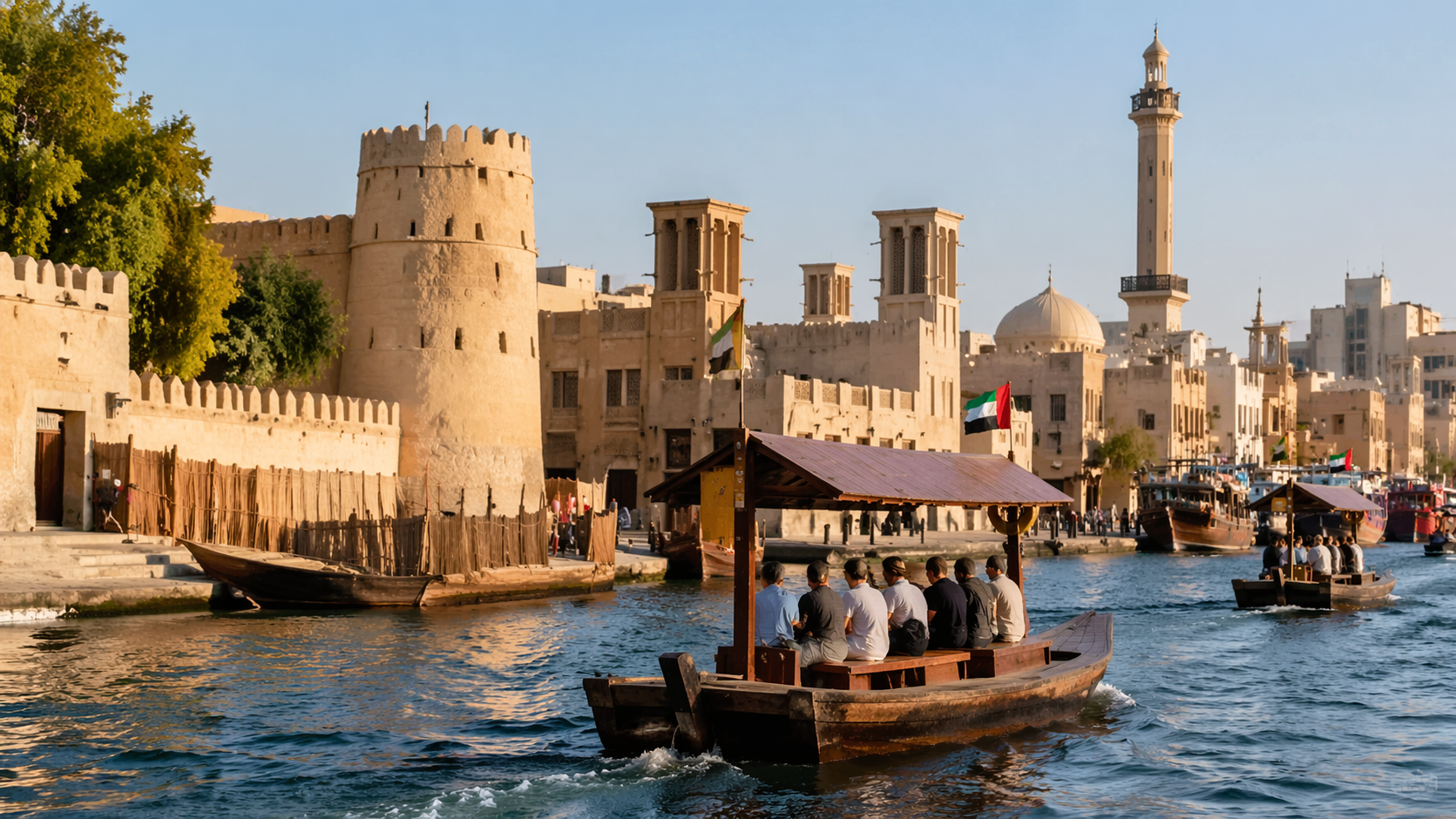
Dubai Creek is a tidal inlet that divides the old city into two banks, Bur Dubai, where Al Fahidi sits, and Deira, where the old markets are concentrated. Between the two banks run wooden abra boats – they've been making this crossing since long before bridges and the metro existed, and they're still at it.
The abra is its own experience. You sit on a wooden bench facing the water, the motor putters along, traditional wooden dhows drift past, and for a few minutes you get the genuine feeling that time has stopped. Nothing else in Dubai gives you that.
The abra docks sit right at the edge of the Al Fahidi neighborhood, along the Bur Dubai waterfront. Boats run from early morning until midnight, with departures every few minutes.
The Spice Souk: follow your nose
On the other bank of the Creek, in the Deira district, a different Dubai begins – loud, dense, and wildly multinational. There are no restored historic quarters here, no art galleries. This is where people actually trade.
The Spice Souk is a short walk from the abra dock. You don't need a map to find it – just follow the smell. Saffron, cinnamon, cardamom, star anise, dried lime: you start picking it up a few blocks away. When the scent becomes thick and almost physical, you're there.
The market fills several narrow lanes under covered arches. On both sides, small shops spill out onto the alley in front of huge fabric sacks stuffed to the top: cinnamon sticks as thick as your wrist, mountains of purple sumac, yellow drifts of turmeric, red pepper pods, pale green cardamom shells.
Beyond spices, the market carries dozens of tea varieties, Arabic coffee (roasted fresh every few days at home in most households here), dried dates and figs, aromatic oils, and bakhoor – fragrant incense that vendors burn in small burners right inside their shops. That smell mingles with the spice in the air, and the result is something completely singular, unlike anything else.
Bargaining here is normal and expected. The first price a vendor quotes is a starting point, not a final offer. If you're buying several packets at once, they'll come down more readily.
The Gold Souk: where gold gets sold by the kilo
A few minutes' walk from the Spice Souk is the Gold Souk. This is not a metaphor or an exaggeration: gold is literally everywhere you look. Covered galleries, every single display case packed with bracelets, necklaces, earrings, rings – all of it glittering and catching the light under the market lamps.
Dubai tightly regulates the quality of gold jewelry: every piece is hallmarked, and fakes are extremely rare. The price is set by the weight of the piece plus the jeweler's labor – a more transparent formula than what you'll find in most jewelry stores back home. Bargaining is both acceptable and encouraged, especially on the labor markup.
The neighborhood's star attraction is the "Najmat Taiba" ring – "Star of Taiba." A massive 21-karat ring weighing 64 kilograms, half a meter in diameter, set with more than five kilograms of precious stones and diamonds. It's in the Guinness Book of World Records, and it sits right in a shop window for anyone to look at and photograph – it's not for sale. The estimated value is three million dollars.
Even if you have no intention of buying anything, the Gold Souk is worth walking through just for what it is: there's no higher concentration of jewelry per square foot anywhere else on earth.
The Textile Souk and Perfume Alley: less famous, just as good
Most tourists know about the spices and the gold. Almost none of them know about two other Deira markets that deserve just as much attention.
The Textile Souk is located on the Bur Dubai side of the Creek, right along the waterfront. Business here runs the same way it has for centuries: bolts of fabric lean against the walls, vendors unroll them across the floor and cut whatever length you need. Silk from India, brocade from Iran, cotton, organza, velvet. If you sew at all, or if you simply love beautiful fabric, this place will undo you in the best possible way.
The perfume market deserves its own conversation. Dubai trades in Arabic fragrances – oud (fragrant wood), musk, rose water. These are not the scents that a Western nose is used to: they're denser, richer, more tenacious. Many vendors will mix a custom blend right in front of you – combining several components in a small bottle and letting you smell it again and again until it's right. It's a slow process, and a genuinely pleasant one.
How to organize your day in Old Dubai
The route is straightforward, but it requires an early start. Heat in Dubai is a serious variable, by midday, walking in direct sun is uncomfortable even in winter, and in summer it's simply not an option.
Start with Al Fahidi – arrive around 8 or 9 in the morning, while the lanes are still empty and the air is cool. Spend an hour and a half to two hours wandering without a rush, stop into the Dubai Museum, and get coffee in one of the courtyards.
Then head to the waterfront and take an abra. Cross to Deira and walk to the Spice Souk. Pick up whatever you want, then move on to the Gold Souk. Both markets run roughly from 9 a.m. to 10 p.m., with a short break during afternoon prayer times.
If you've still got energy – the Textile Souk on the way back, then another abra home. The whole route on foot takes four to five hours, costs almost nothing, and gives you more of the real Dubai than a week in the malls ever could.
A few last pieces of advice
Dress modestly – shoulders and knees covered. It's not a strict requirement for tourists, but in a historic neighborhood it's a sign of respect that people notice and appreciate.
Bring cash. Cards aren't accepted everywhere, especially at the Spice Souk.
At the Spice Souk in the morning, accept the Arabic coffee that vendors will offer you straight from a thermos – no prompting, no charge. It's part of the trading ritual: offer hospitality, start a conversation, earn some goodwill.