

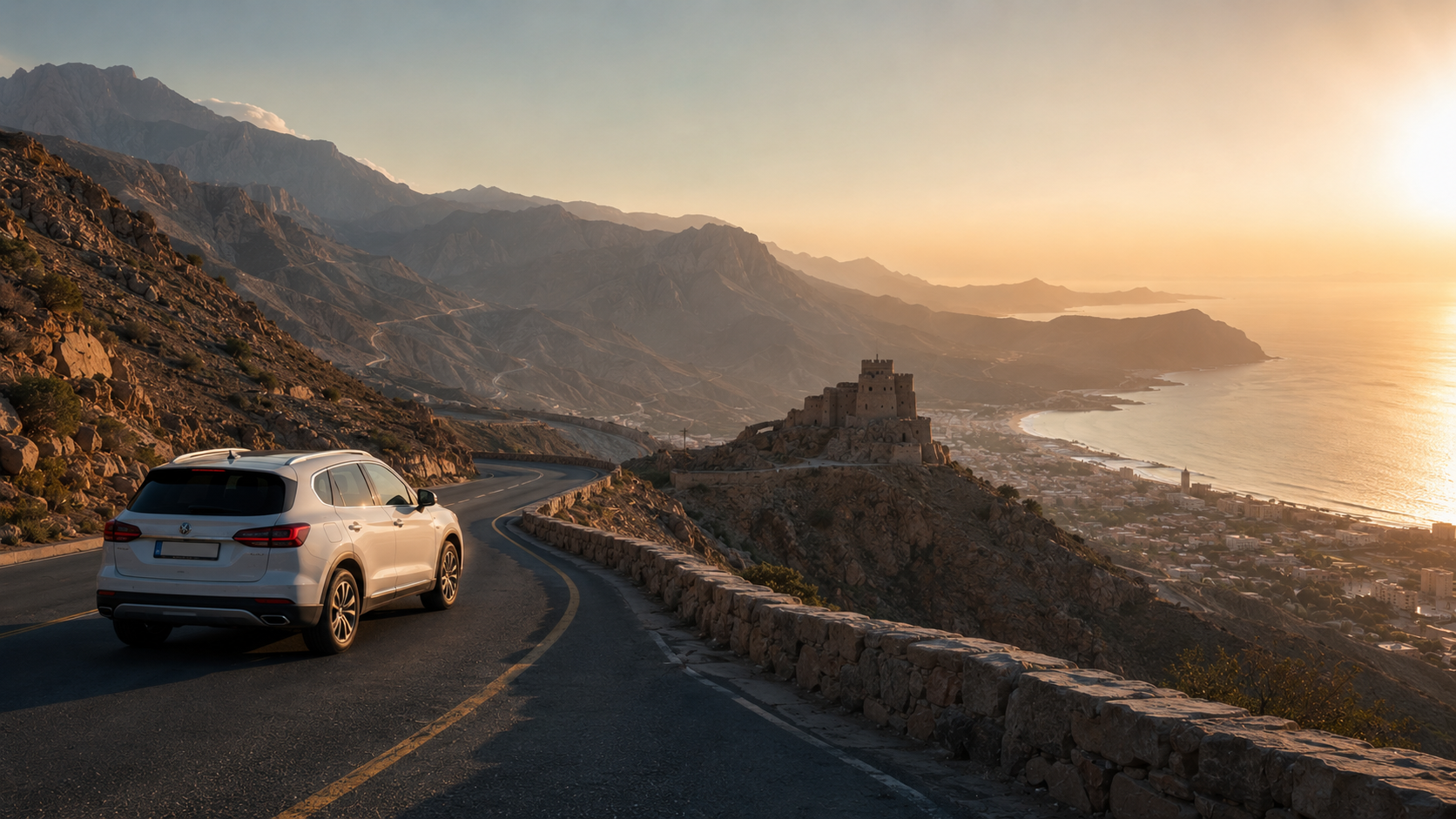
The main reason to head to Ras Al Khaimah is Jebel Jais, the country's highest point. The paved switchback road climbs through the folds of the Hajar Mountains, which are over 70 million years old, past lookout points with views of endless ridges. The road itself is already an attraction: smooth curves, changes in elevation, ear-popping pressure, and noticeably cooler air at the top.
At the summit there's something to suit any personality:
- Jais Flight – the longest zipline in the world, listed in the Guinness Book of Records. The cable, about 2.83 km long, is strung at a height of roughly 1,680 meters above sea level, and the flight speed in the "superman" position reaches 150–160 km/h. About three minutes of pure adrenaline above the canyons.
- Jais Sledder – the longest mountain "sled" in the country. a track of nearly 900 meters, with speeds up to 40 km/h. A great option for families with children.
- Jais Sky Tour – a series of smaller ziplines that guide you through the gorges, for those who want to stretch out the fun.
When you feel like taking a break, drop by the restaurant 1484 by Puro – the highest dining spot in the country, at the 1,484-meter mark. The panoramic windows and terraces look straight out onto the mountains, and the menu is put together from dishes from around the world, it's especially beautiful here at sunset. Once darkness falls, Jebel Jais offers something you won't find in the city – a truly starry sky. Many people stay overnight at a campsite or on "star beds" out in the open air and greet the sunrise from above the clouds.
History that's best toured only by car
Ras Al Khaimah isn't just about adrenaline – it's also one of the oldest inhabited territories in the region. And nearly all of its historical gems are most conveniently tied into a single route in your own car.
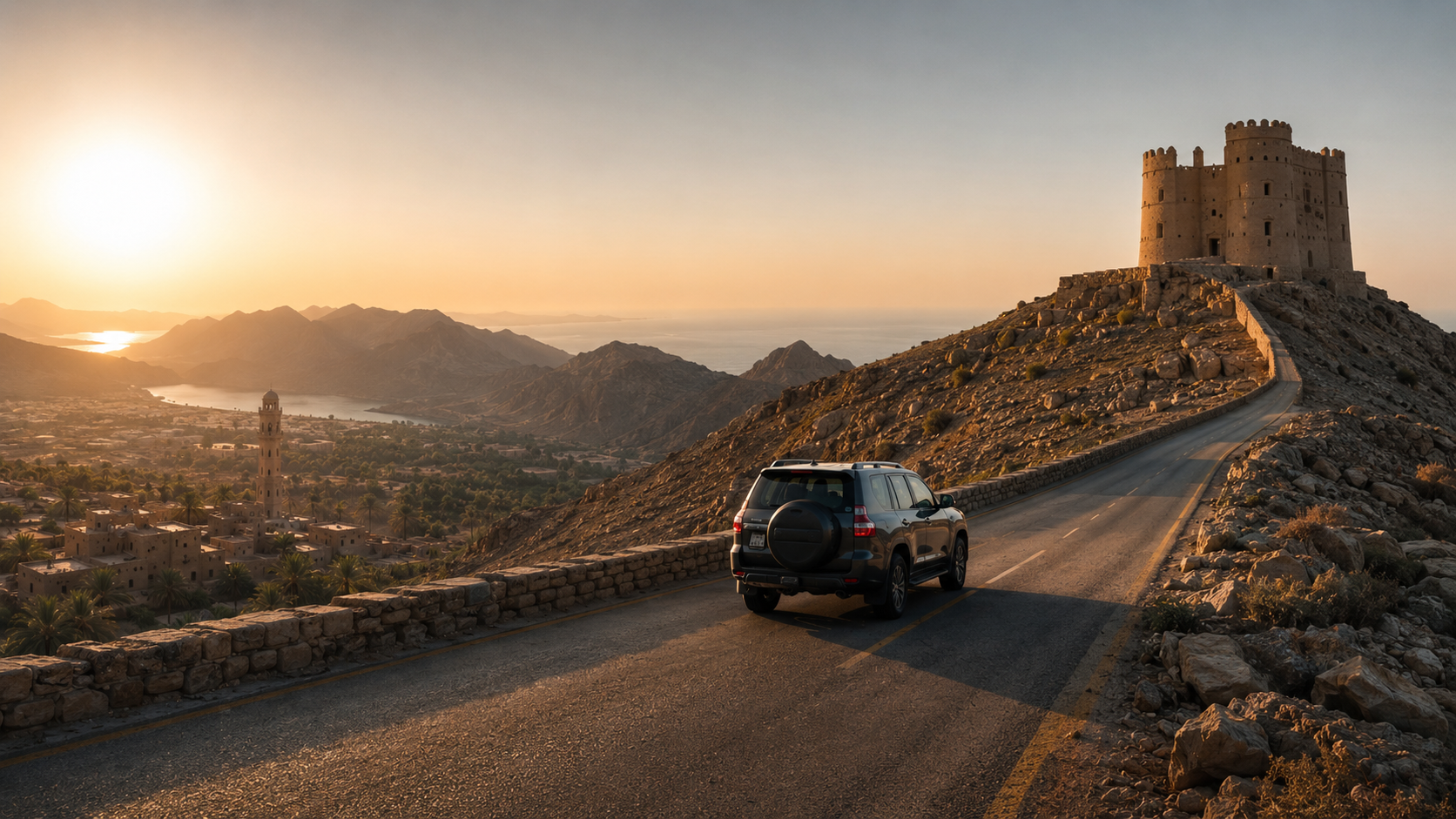
Dhayah Fort – the only surviving hilltop fort in the UAE. To climb up to it, you have to tackle 239 zigzagging steps, but the reward is worth it, from the top, a panorama of date palm groves, mountains, and the sea opens up. Once, in 1819, a battle between local tribes and British troops unfolded here, and the fortification itself stands on foundations dating back to the Bronze Age.
Al Jazirah Al Hamra – the famous ghost town. This former pearling village was abandoned by its inhabitants in the 1960s, but more than 400 houses of coral stone, a mosque, and narrow streets have been preserved almost untouched. Today it's a free open-air museum, wrapped in legends about jinn spirits – a place beloved by photographers and fans of atmospheric stories.
Suwaidi Pearls Farm will remind you what this land lived on before the oil era. On a traditional boat, you'll be taken along the mangrove thickets, told about the techniques of the pearl divers, and right in front of you they'll open an oyster – possibly with a real pearl inside.
Sea, islands, and sunsets
After the mountains and the history, it makes sense to wrap up the route by the water. Al Marjan Island – a man-made archipelago with beaches, resorts, and a family park, a pleasant place to spend the second half of the day. Those who love quiet will appreciate Flamingo Beach and Rams Beach, calm waves, soft sand, and a sky turning pink at sunset. And for souvenirs and the atmosphere of an Eastern bargaining session, head to the old market in the center of town – here it's customary to haggle, and that's part of the local culture.
A rough two-day plan
So you don't end up dashing between spots, it's handy to split the trip into two days. On the first – an early-morning departure from the city, the climb up Jebel Jais, activities in the mountains, lunch with a panorama at 1484 by Puro, and an overnight stay up top under the stars or at a hotel at the foot of the mountain. On the second day, head down to the coast: Dhayah Fort with its views, a walk through the ghost town of Al Jazirah Al Hamra, a visit to the pearl farm, and closer to sunset – the beach and an unhurried drive back to Dubai. That rhythm leaves time for the spontaneous stops that are, after all, the whole reason to take a car.
What's important to know before the trip
When to go. The best time is from November through March, when the heat lets up and mountain outings become a real pleasure. The activity season on Jebel Jais usually runs until about April, after which it gets noticeably warmer at altitude.
Which car to choose. For the mountain switchbacks and the trips between far-flung spots, an SUV or a crossover is the most comfortable, a reserve of power on the climbs, a high seating position, and a roomy trunk for your overnight gear. But if the experience matters more to you than the luggage, a sporty sedan is a perfect fit – and in the cool season, a convertible with the top down.
Documents and rules. Keep your passport on you, your national driver's license, and an International Driving Permit if you're a traveler. Speed limits in the UAE are strictly monitored by cameras, and on a mountain road it's especially important to obey the limits and not get distracted by the views – there are safe lookout points set up everywhere for photos.
The little things that help. Bring water, sunglasses, and a warm sweater, up top it's a few degrees cooler than down by the sea. It's best to book tickets for the zipline and other popular activities in advance – in high season the slots get snapped up very quickly.
Freedom begins with the ignition key
Ras Al Khaimah is one of those cases where the road is no less interesting than the destination. A mountain, a fort, a ghost town, and a beach in a single weekend come together into one route only when you're not tied to a schedule and can stop wherever you feel like it. That's exactly why a rental car here isn't an extra line item in your budget – it's the key to freedom of movement.
Pick the right car – from an economy crossover to a stately SUV – and set off to discover the Emirates beyond the familiar silhouette of Dubai. The country's summit is already waiting.


