

Renting a car gives you complete freedom in Dubai, you decide when to head to the beach, swing by the desert, or take off to a neighboring emirate. But there's one detail that surprises almost every visitor when they return the car – the "Salik" line on the final bill. What it is, how much it costs, and how to avoid overpaying – let's break it down step by step.
What Salik is and how it works
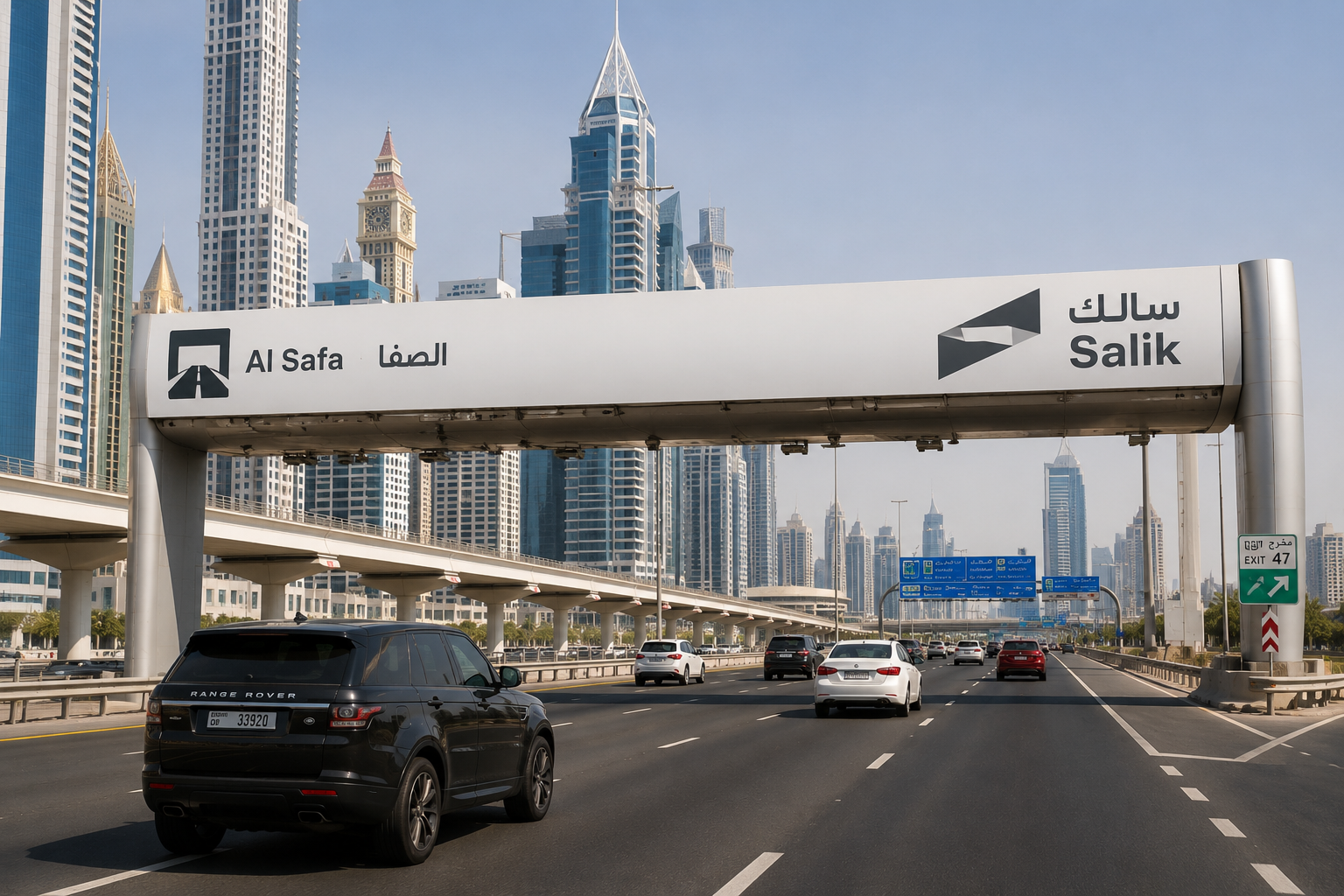
Salik (Arabic for "open" or "clear") is Dubai's electronic toll road system. It launched back in 2007 to do away with traditional barriers and keep traffic moving. Today it's a fully contactless technology, gantries with RFID readers are mounted over the road, and a small sticker-tag is fixed to the windshield of every vehicle. When a car passes under a gate, the charge is deducted automatically – there's no need to stop or even slow down, and traffic flows without interruption.
There are ten such gates across the city, and they're positioned on the key arteries, along Sheikh Zayed Road, near the bridges over Dubai Creek, by the airport, and at the tunnels. Driving through central Dubai without ever crossing a toll zone is nearly impossible – which is why understanding how Salik works is useful for anyone getting behind the wheel.
How much a crossing costs in 2026
The rate used to be fixed, but since the start of 2025 Dubai has used dynamic pricing – the cost depends on the time of day:
- During peak hours (6:00 a.m. to 10:00 a.m. and 4:00 p.m. to 8:00 p.m. on weekdays) – 6 dirhams per gate.
- During off-peak hours (10:00 a.m. to 4:00 p.m. and 8:00 p.m. to 1:00 a.m.) – 4 dirhams.
- At night, from 1:00 a.m. to 6:00 a.m., crossings are free.
- On Sundays, a single rate of 4 dirhams applies throughout the day.
During the month of Ramadan, the schedule is adjusted to fit the city's changed rhythm. It may sound like small change, but if your daily route runs through three or four gates, the difference adds up. A simple example, a trip through three gates during peak hours costs 18 dirhams, while the same drive at a quieter time costs 12. Over a week of active driving, that builds into a meaningful sum you can easily save just by shifting your departure by an hour.
There's a nice catch, too, linked gates that stand in pairs (for example, Al Mamzar and Al Safa) count as a single charge when you pass them in the same direction within an hour. So you won't be billed twice for a short stretch.
How Salik works specifically with a rental car
This is probably the main question for travelers. The good news, you don't need to register anything, buy a tag, or top up an account yourself. The car is handed over with a Salik tag already installed and active, and the account is tied to the rental company rather than to you personally.
In practice, it works like this, all your crossings during the rental period are recorded and then billed – either deducted from the deposit or added to the final invoice when you return the car. At alligator.rent, Salik crossings are charged transparently and as incurred – you pay only for the gates you actually passed.
Can you avoid the toll roads – and should you?
Technically, yes. Dubai has major highways with no Salik gates, E311 (Sheikh Mohammed Bin Zayed Road), E611 (Emirates Road), and Al Khail Road (E44). But is it always worth it? Not quite. Of course, a detour almost always means extra miles, more time behind the wheel, and sometimes more fuel. Saving 4 to 6 dirhams at a single gate is unlikely to justify an extra half hour on the road under the blazing sun.
And if you love the city at night, you get a bonus – from 1:00 a.m. to 6:00 a.m. all gates are free. The Burj Khalifa lit up, an empty Marina promenade, cool air – a perfect time for a relaxed drive without a single charge.
How to check and pay Salik
Even if the rental company handles the billing, it helps to understand how it all works. You can check your balance and crossing history in several ways:
- the official Salik app and website;
- the RTA Dubai app;
- the Dubai Now super-app.
For a private vehicle, there's a rule, if the Salik account doesn't have enough balance at the moment of a crossing, the owner is given a few business days to top it up, otherwise a fine of around 50 dirhams may apply. But with a rental, that's the company's headache, not yours – one more solid argument for renting from a reliable service rather than private listings.
What about the neighboring Emirates?
If you're planning a trip beyond Dubai, keep in mind that Abu Dhabi has a toll road system too – it's called Darb and works on a similar principle across several pricing zones in the capital. Sharjah, Ajman, Ras Al Khaimah, Fujairah, and Umm Al Quwain, on the other hand, remain completely toll-free. So a journey to the Hatta mountains, the beaches of the east coast, or the green oasis of Al Ain won't come with any extra road charges.
Frequently asked questions
Do I need to buy a Salik tag myself? No. A rental car already comes with a working tag – there's nothing to set up.
How much does Salik usually cost for a day around the city? Typically 8 to 16 dirhams, if your route runs through two to four gates. The exact amount depends on the area and the time of day.
Will the crossings be listed separately on the bill? With transparent companies – yes, you'll see an itemized breakdown for each gate.
Can I avoid Salik altogether? You can drive on roads without gates or use the free overnight hours, but fully avoiding the toll stretches in central Dubai is difficult.
At alligator.rent, there's a wide selection of vehicles for any scenario, fuel-efficient models for daily drives around the city and spacious SUVs for trips beyond it. Every car is already ready for Dubai's roads, Salik included. Book online in a couple of minutes and set off to explore the Emirates with no extra questions.


