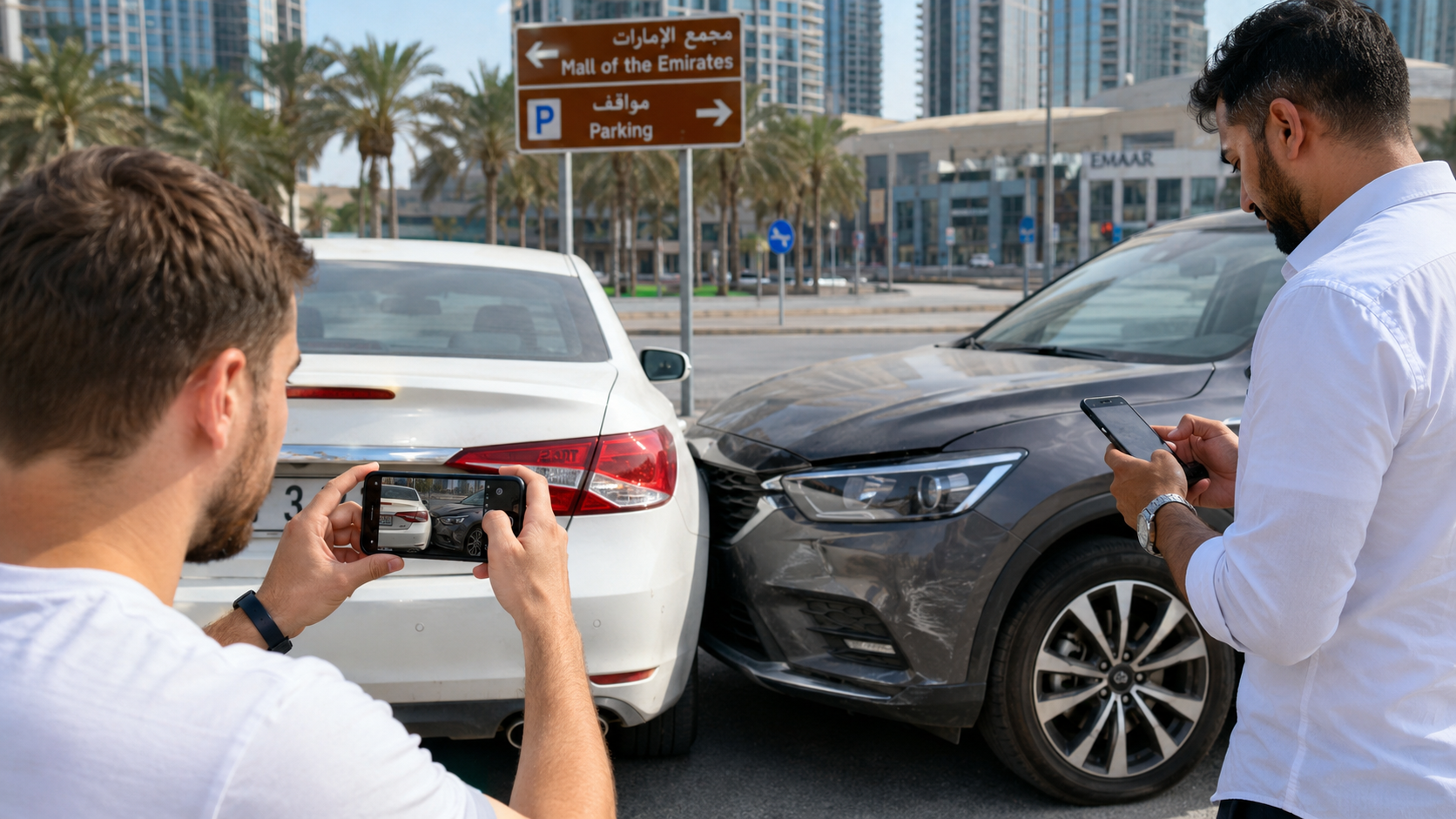
We get this call roughly every other week. A client messages us on WhatsApp, typing fast: “We’re in the car park at Mall of the Emirates, someone reversed into us. It’s a scratch, nothing serious, the other guy is offering five hundred dirhams in cash and we go our separate ways. That works, right?”
It doesn’t. And this is probably the single most useful thing to know about driving here – more useful than speed limits or lane discipline.
The paperwork decides everything
In the UAE no garage will repair a car without a police report. Not “it’s better to have one” – they simply won’t take the job. The insurer pays nothing, and the rental company takes the full repair cost out of your deposit. The report isn’t a box-ticking formality, it’s the document that decides who pays.
Which brings us to the part visitors struggle with most: settling in cash at the scene is a bad move. Even when the other driver genuinely wants to keep things friendly. Even when the sum looks trivial. Without a report you just pay twice – first him, then us.
The first few minutes
The list is short, but the order matters.
People first. If anyone is hurt, dial 999. The ambulance comes through the same number. Everything else can wait.
Then the car. If the impact was small, nobody is injured and both vehicles still drive, move them out of the lane – onto the hard shoulder or into a car park. This isn’t a suggestion. Leaving cars sitting in traffic after a minor collision carries a fine, the amount varies by emirate and starts at around 500 dirhams. The reasoning is easy to follow – on Sheikh Zayed Road a stationary car causes a second accident faster than you can pull out your phone.
The exception: injuries, serious damage, a car that won’t start. Then touch nothing, hazards on, wait.
Next, photos. Lots of them. A wide shot with landmarks in it (a sign, the parking level number, the road markings), both cars in full, close-ups of the damage, the plates, and the position of the vehicles before you moved apart. Take them in the police app once you get to the report stage – the system won’t let you upload pictures from your gallery, so the shots have to be taken there and then.
And swap details: name, phone, driving licence number, Emirates ID, plate number, insurer.
Where to actually report it
You don't need to call 999 for a minor bump – the police themselves ask you not to. There are three options that work.
The Dubai Police app. Look for Minor Traffic Accident Report. Vehicle details, license numbers, photos – five to ten minutes. The report lands in your inbox or arrives by SMS, usually within a day. It works for tourists, you can log in with passport details.
A petrol station. More than 130 ADNOC, ENOC and Emarat stations run the On-the-Go scheme, where trained staff photograph the damage and file the report for you. Handy if the app is being difficult or the other driver's English has run out. Bring your passport, license and rental agreement.
901. Dubai Police's non-emergency line. They'll tell you what to do in your particular situation – say, when the other driver disagrees about what happened. That, incidentally, is exactly when it's worth asking for a patrol: the app assumes both parties already agree on who hit whom.
Federal law gives you three hours to report an accident. In practice, the sooner you deal with it, the less it costs you in nerves.
Pink, green, white
The report comes with a colour code, and it's the most important line in the whole document.
Green – you're not at fault, the other side pays (their insurer, to be precise). Pink, sometimes called red – you are at fault. White – fault hasn't been established and it's still being looked into.
Here's what that means for a renter. With a green report you usually pay nothing beyond a small administrative fee. With a pink one you cover the excess, and the figure is written into your rental agreement – typically AED 1,500 to 3,000 for an economy sedan, noticeably more for sports cars and premium models. Drivers under 25 often face a higher excess on top.
The report is valid for three months. Don't lose it, and don't leave the only copy in the glovebox.
Call us before you call the insurer
The rental company isn't the last stop, it's the first. We need to know two things: whether the car still drives or needs a recovery truck, and where you are. After that we'll tell you where to take it and handle the insurance paperwork ourselves.
There's a financial reason not to sit on it, too. A car sitting in a workshop isn't earning, and most agreements include a loss-of-use clause – compensation for downtime at the daily rate. The later the car reaches the garage, the longer that meter runs.
A separate story: kerbs, pillars and mystery dents
No second driver involved? Still an accident. Clipping a pillar in an underground car park, catching a kerb on a U-turn, losing a mirror to a wall – all of it goes through the same process, and none of it gets repaired without a report.
The more annoying version: you come back to the car and there's a fresh dent in the door with nobody around. The app has a category for exactly this, an "unknown accident". You declare the damage, attach photos, pay a fee (a few hundred dirhams; they'll quote the exact amount when you file) and get the document your insurer needs. Paying for someone else's mistake stings. The alternative costs more.
If it happened outside Dubai
Drove to Hatta, Fujairah or Ras Al Khaimah for the weekend and picked up a scrape there – the procedure is similar, but the emirate is different. In Abu Dhabi minor accidents are handled by Saaed through its own app. Elsewhere the simplest move is 999, and the operator routes you to the right department. The color-coded reports and the no-report-no-repair rule work the same way across the whole country.
A short list of things not to do
Do not leave the scene of the incident. That is the costliest mistake you could make. You face fines, penalty points, and vehicle confiscation, if there are injuries, the situation escalates to a completely different level – involving damages amounting to tens of thousands of dirhams.
Don't admit fault on the spot. Your "sorry, I didn't see you" can end up shaping the fault decision. State facts, save the emotions for later.
Don't argue or raise your voice. It helps with nothing here, and it can add problems of its own.
Don't arrange repairs yourself, even if a friend's garage in Al Quoz "will sort it for a hundred dirhams". The car isn't yours, and touching an insured vehicle without a report has legal consequences attached.
And, of course, alcohol. The UAE enforces a zero-tolerance policy, and any insurance policy is voided the moment a test returns a positive result.