Every few weeks someone asks us a version of the same question, usually on a Wednesday, usually about the weekend that starts in two days. “We were thinking of driving to Muscat. Or Musandam. Can we just take the car?”
The answer is yes. The catch is that the trip doesn’t begin at the Hatta turn-off, it begins in an office about a week earlier, with paperwork. Get that part right and Oman is one of the easiest international road trips on the planet. Get it wrong and you’ll spend an afternoon being politely turned around at a border post, which is a memorable way to lose a weekend but not the way anyone hopes.
Here’s the honest version of what’s involved.
The letter that decides everything
A rental car isn’t yours. Border officers know this, and they will not let a vehicle leave the country on the word of the person sitting in it.
So you need a No Objection Certificate – an NOC – issued by the rental company. It’s a letter on company paper, notarised, in Arabic, naming you, your passport, the car’s plate and chassis number, and the dates you’re allowed to be out of the country. Without it, the answer at the counter is no. There is no talking around it, no “but we’re only going for two days”.
Two things people underestimate. First, this isn’t instant: give the company several days, ideally a week. Second, cross-border travel is a paid add-on, not something included in a standard rental. Budget somewhere in the region of AED 400–800 all in, depending on the company, the car and how long you’ll be away. And ask specifically whether your category of car is even eligible.
Which specific boundary is it – and why can’t one simply choose one of them?
There are five border crossings between the two countries. For most people traveling from Dubai, the Hatta–Al Wajajah crossing is the best option, it operates around the clock, is well-organized, and connects to the road leading to Muscat.
But, and this trips people up constantly, the border isn’t your choice, it’s your rental company’s. Some agencies specify a particular border crossing in the NOC document. There have been instances where vehicles were denied entry at the Khatmat Malaha or Al Dara checkpoints, even when all the necessary paperwork was in order. Verify exactly which crossing your NOC is valid for and use that specific one – regardless of any shorter routes suggested by a navigation app.
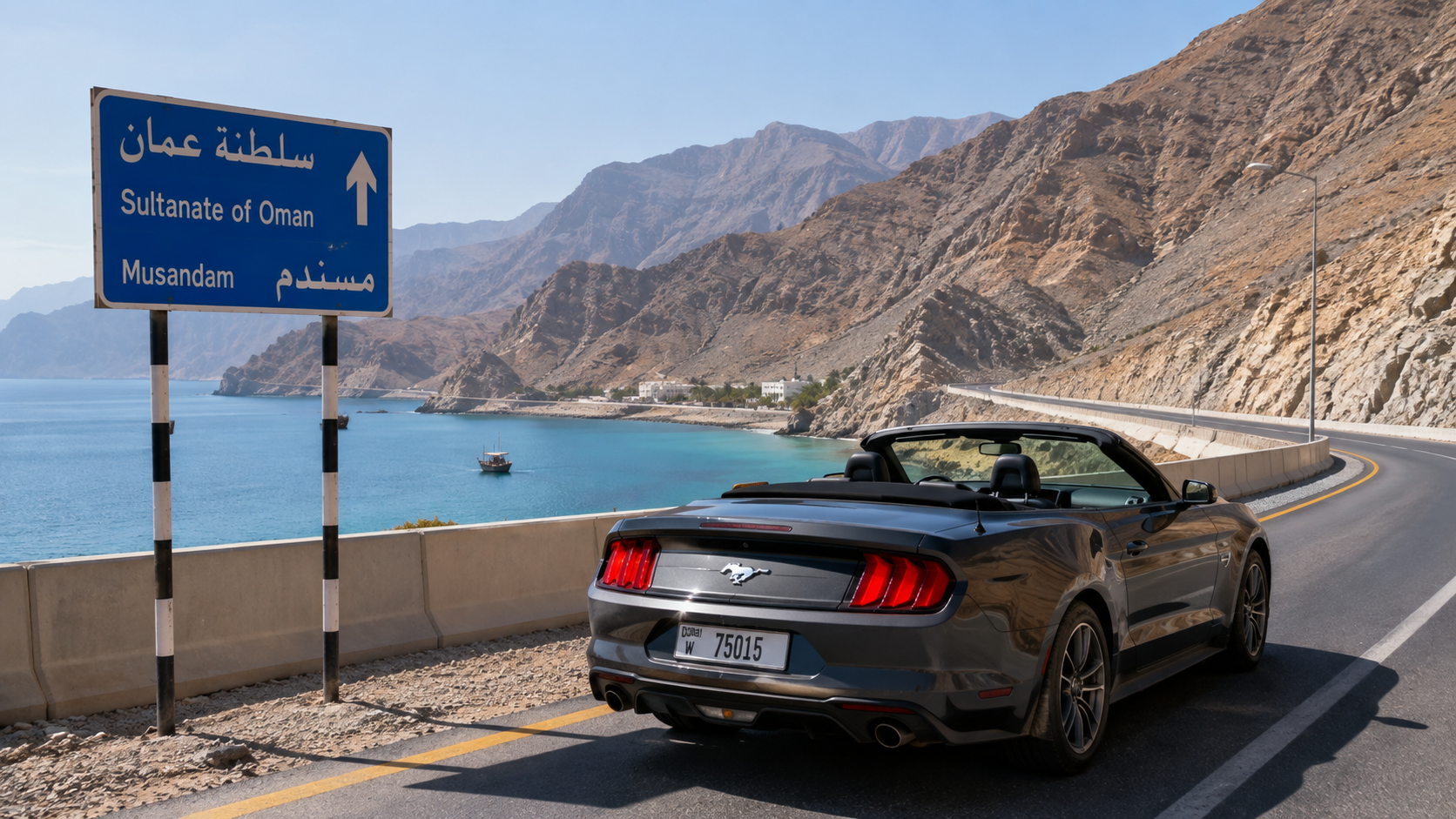
If you are heading to Musandam rather, than the main part of Oman, the route will be completely different, the journey takes you through Ras Al Khaimah and the Al Dara border crossing. It involves a three-to-four-hour drive instead of five, fjords instead of desert, and entirely different rules. Be sure to check the details in advance – do not assume that conditions are the same everywhere.
What the crossing actually looks like
Three stages, and none of them are complicated.
UAE exit first, you pay AED 35 plus VAT per person, get a receipt, hand it over with passports at the next window, get stamped out. Cash works, card works, but bring dirhams anyway.
Then Omani immigration. UAE residents can usually get a visa on arrival – around 5 Omani rials, valid two weeks. Tourists are a different story, a lot of nationalities now need an eVisa arranged in advance through the Royal Oman Police portal, and turning up hopeful is not a plan. Check your own passport's status a couple of weeks out.
Then comes customs, an officer checks the registration card, the "orange card," and the No Objection Certificate (NOC), and usually takes a look inside the vehicle.
Thirty minutes on a quiet Tuesday morning. Two hours on the first day of Eid. Cross early if you can.
Roughly what it costs
A cross-border fee charged by the rental company (around 105–115 dirhams for insurance), a 35-dirham-per-person fee for leaving the UAE, approximately 47 dirhams for a visa, and fuel costs – which, incidentally, become lower after crossing the border (though not by much).
The driving
The roads in Oman are excellent. The highway to Muscat is fast and, by UAE standards, uncrowded. Here is what you should know regardless, Oman strictly enforces speed limits, and cameras are everywhere. Download offline maps before entering the country, as roaming services may be unavailable or prohibitively expensive. And if you are tempted to drive along a wadi bed, driving a standard passenger car over gravel is exactly the kind of scenario insurance companies are least likely to cover.
Where people actually go
A weekend in Musandam, a trip on a traditional boat, cliffs plunging into the water, and a return on Sunday.
If you prefer exploring the country's interior over the coast, head to Nizwa and Jebel Shams, you will find fortresses, mountain terrace villages, and a canyon that truly lives up to all the glowing comparisons. Bear in mind that a 4×4 vehicle is essential for the final stretch of the ascent to Jebel Shams, this is not merely a marketing ploy, but a genuine necessity.
Salalah is 1,000 km further and belongs to a different kind of holiday.
What sends people home at the counter
Passport with under six months left on it. An NOC for a border you didn't use. A single-entry UAE visa, which gets you out and then very much doesn't get you back in. UAE residency, that expired last week. And the classic, assuming the rental company will "sort it out" on the morning of departure.
None of these are edge cases. They're the whole list of what goes wrong.
Oman rewards the effort. The one thing that never works is leaving it late – a Wednesday phone call about a Friday departure doesn't give anyone time to produce a notarised document.
So if Oman is on your list, raise it before you book, not after. Message us with your dates and where you're headed and we'll tell you straight away what's possible with which car – including if the honest answer is that the trip is better done in a car hired on the other side of the border.