A significant number of our clients renting accommodation for a month are not tourists. They are people who have just moved here – facing a new job, a new apartment, enrolling their children in school, and a to-do list that fills an entire notebook. Somewhere on that list is “sort out a car.” It looks simple and isn’t, mostly because the rules change partway through your move. What’s legal in your first week can be a violation by your second month. Here’s how it works, stage by stage, and how to stay on the road the whole time.
Stage one: you’ve arrived, but you’re not a resident yet
Most people start on an entry permit or visit visa while their residence visa is processed. At this stage, as far as driving is concerned, you’re treated like any visitor.
That means you can rent a car on your home licence, with an International Driving Permit if your country requires one. The requirements are the same as for any tourist, and renting works the same way.
This stage often lasts a few weeks, and it’s the easiest one. Enjoy it, because the next step is where people get caught out.
Stage two: the residence visa arrives, and the rules change
This is the key point, and it surprises a lot of people. Once you have a UAE residence visa, you can no longer drive on your foreign licence. You need a UAE one.
It doesn’t matter that your licence is still valid, or that you drove on it perfectly well last week. A resident driving on a foreign licence is breaking the traffic law. There’s a practical side too, if something happens, an insurer may refuse to pay out for a driver who was a resident without a UAE licence. That can turn a small accident into a very expensive one.
So from the day your visa is stamped, the clock starts. Plan the switch before you need it, not after.
Exchange or driving school: which one you get depends on your licence
The UAE has a list of countries whose licences can be exchanged directly for a UAE licence, no driving school, no theory exam, no road test. Right now it covers 57 licence origins, including the UK, the US, most EU countries and several others. The list changes over time as new agreements are signed, so check the current version with the RTA before planning around it.
If your country is on the list, the process is quick. You’ll typically need:
-
your Emirates ID (or the application receipt if it’s still being processed) and passport with your residence visa;
your original foreign licence, which is usually kept when you receive the UAE one;
an eye test from an approved optician;
Many people complete the process in a single visit.
If your country is not on the list, the procedure will be different. You will need to complete a driving school course – including theory and practical lessons, an internal assessment, and finally the RTA’s official driving test. Expect this to take anywhere from a few weeks to several months and cost several thousand dirhams. Start early, many people underestimate how long the waiting lists for exams can be, especially during peak season.
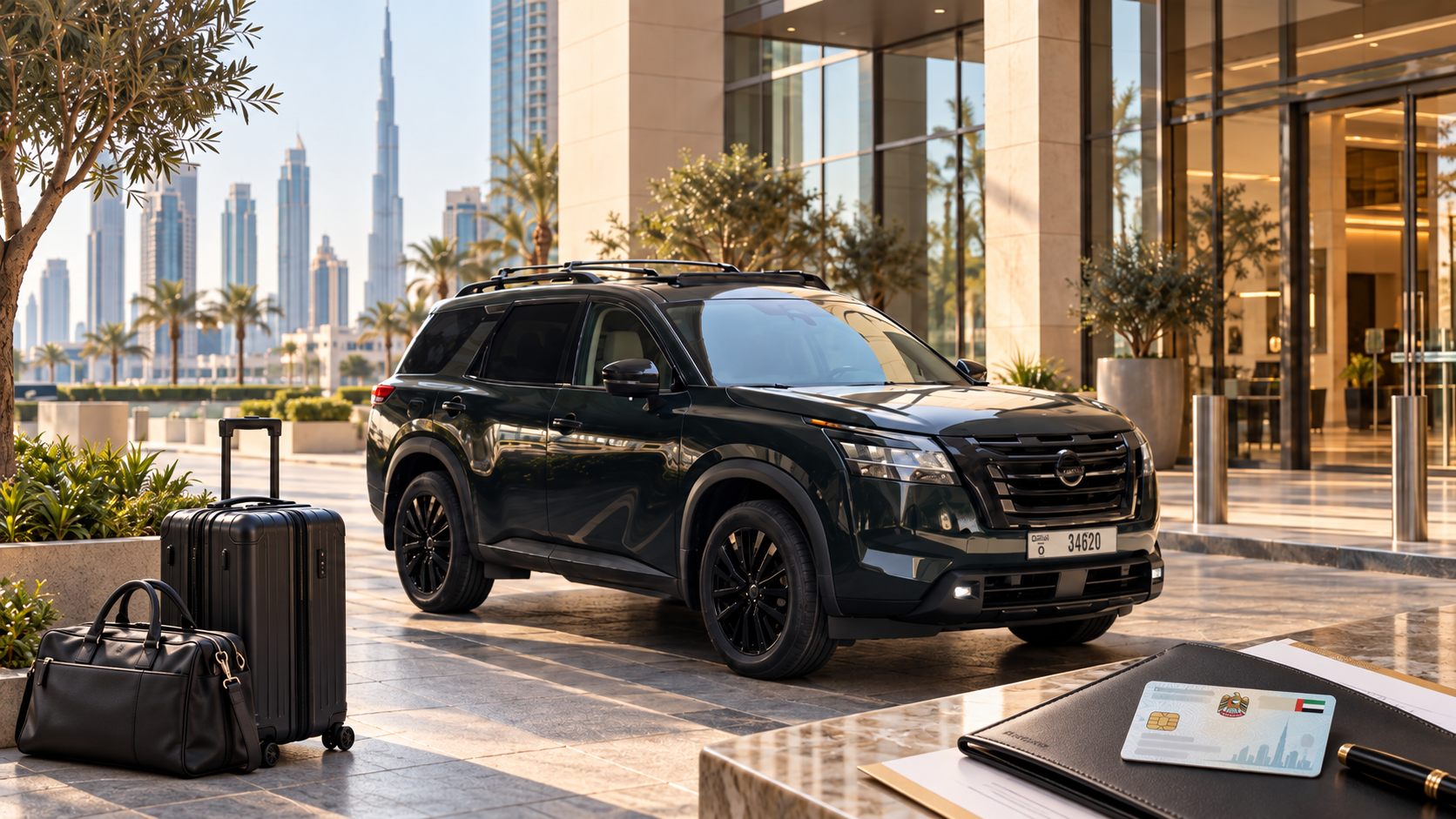
Why buying a car straight away is usually a mistake
When moving to a new location, your first instinct might be to buy a car and get that sorted out. Nevertheless, there are several reasons not to rush during the first few months of your stay in Dubai.
First of all, you will not be able to register a car for the time being. To purchase a vehicle and register it in your name, you need a UAE residence visa and a UAE driver’s license. Until you have both documents in hand, buying a car is either impossible or requires finding workarounds.
You don’t know what you need. The car, that makes sense depends on where you’ll live and work, and many newcomers change flats after the first lease. A compact car is ideal for Downtown and Business Bay. Commuting from Dubai South or Sharjah every day calls for something bigger and more comfortable. Family arriving in three months calls for seven seats. It’s hard to know all of this in week two.
The used market has its own rules. Mileage, service history, Gulf-spec versus imported cars, accident records, all of this is learnable, but learning it while you’re also setting up bank accounts and schools is how people overpay.
Monthly rental as a bridge
This is where a monthly rental works well. It isn’t a permanent solution for everyone, but for the first three to six months it removes a lot of problems at once.
One fixed payment. Insurance, registration, scheduled maintenance and servicing are included. You don’t deal with any of it.
The car can change as your life does. Started in a compact while you were on your own, and now the family has arrived? Switch to an SUV or a minivan. Moved from the Marina to Mirdif? Choose something more comfortable for the commute.
Replacement if something goes wrong. If the car needs a repair, you get another one rather than waiting at a garage.
A lower daily rate. Monthly rental is noticeably cheaper per day than daily or weekly hire, and much cheaper than taxis for a daily commute.
And if in six months you decide to buy, you’ll know exactly what you need, where you’ll live, and how much you actually drive.
One important detail: tell us when your status changes
If you rented a car as a tourist but obtained a resident visa during the rental period, please be sure to notify us. The terms of the agreement must align with your status, as residents are required to hold a UAE driver’s license. This primarily protects you by ensuring the validity of your insurance coverage. If the process of obtaining your UAE license is not yet complete when you receive your visa, please contact us immediately so we can find the best solution for this transitional period.
Just moved to Dubai and not sure which car or rental period suits you? Drop us a message on WhatsApp. We’ll gladly help you work out the easiest way through your first months.