

Every client who picks up a car from us eventually asks the same three questions. Where do I fill up? How much will it cost? And do I really have to return the car with a full tank? Fair questions, all of them, and the answers are simpler than you expect. But there are a few local quirks that catch first-time visitors, so we put together the guide we wish every renter read before their first stop at the pump.
The good news first: fuel here is cheap
Let's start with the number that makes American and European visitors smile. Gasoline in the UAE costs roughly a third of what you pay in Western Europe and noticeably less than the US average. Prices are set by the government at the start of each month and are identical at every station in the country, so there is no point driving across town to save a few fils. ENOC, EPPCO, ADNOC, Emarat: same fuel, same price, different logo on the canopy.
What does that mean in practice? Filling a midsize sedan from near-empty runs somewhere around 150 to 200 dirhams, and a compact costs even less. A full week of active city driving, with a beach day and a desert detour thrown in, rarely burns more than one tank. For many of our clients, fuel ends up being the smallest line item of the entire trip, cheaper than two dinners.
Which fuel goes in your rental
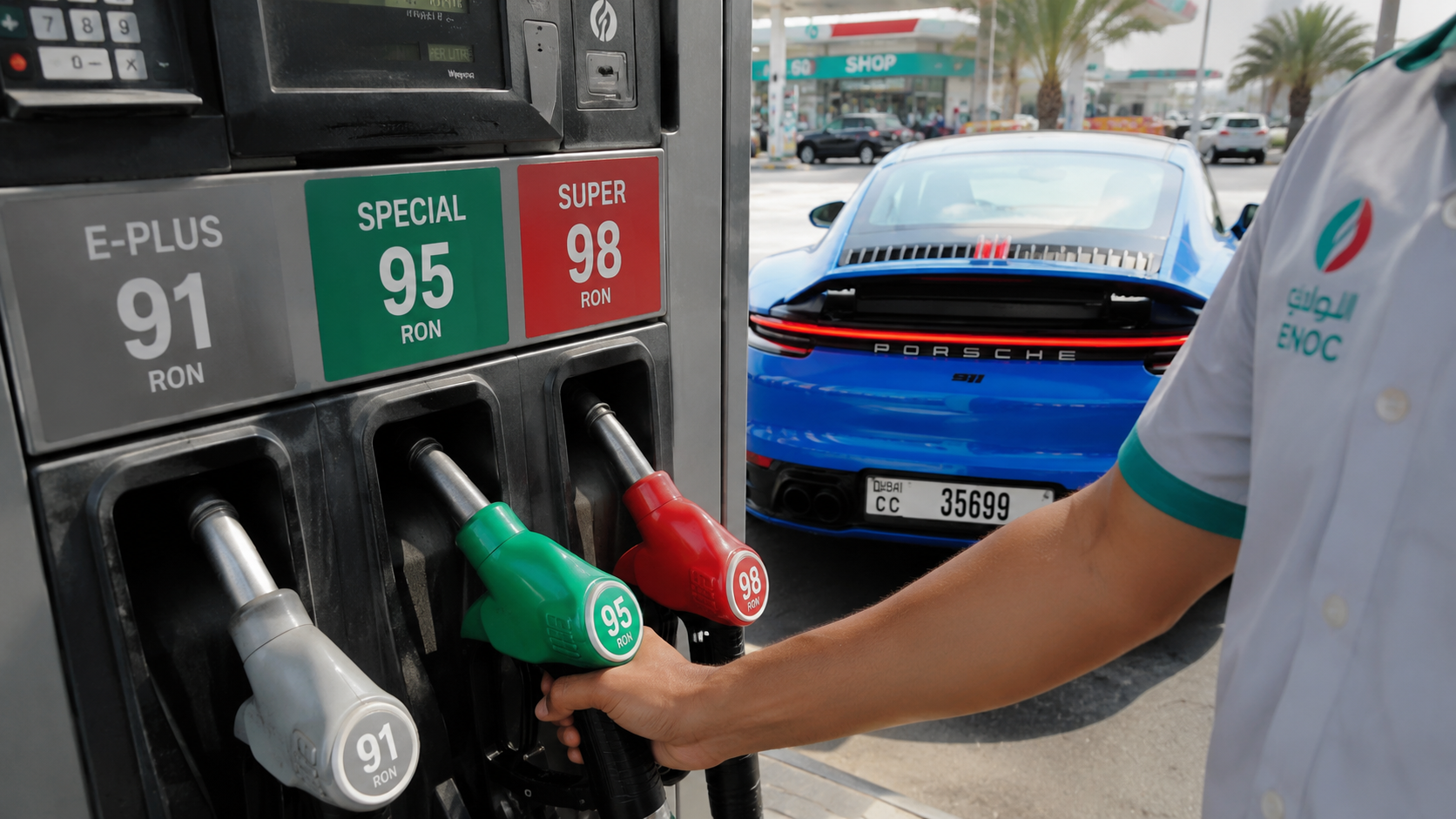
UAE stations sell three main grades: Special 95, Super 98, and E-Plus 91, plus diesel. The overwhelming majority of our fleet, from economy sedans to full-size SUVs, runs happily on Special 95. Sports cars and high-output engines want Super 98, and we tell you this directly at handover, so there is no guessing. The grade is also written on a sticker inside the fuel door on most of our cars, because people forget, and that is fine. We would rather label everything twice than have a client stand at the pump second-guessing.
One thing you will almost never need to worry about: putting diesel in a gasoline car by accident. Diesel pumps are separated, clearly marked, and often physically located on a different island. The system is designed to protect you from the expensive mistake.
Full service is the default, and yes, that feels strange at first
Here is an important local detail: at most gas stations in Dubai, you do not fill up the car yourself. You pull up, roll down the window, and an attendant asks what you need. You specify the fuel type and either a specific amount in dirhams or simply ask for a "full tank." The attendant handles the nozzle – you don't have to do a thing. Payment is made right from the driver's seat: a card terminal is brought to the window, and every station accepts bank cards, smartphone payments, and cash.
Tipping is not mandatory, and most locals do not tip simply for having their tank filled. However, if the attendant also cleans the windshield or checks tire pressure, a five- or ten-dirham note is a nice gesture.
Paying at the pump: cards, apps, and one useful trick
Major gas stations readily accept international Visa and Mastercard cards, and contactless payment is available everywhere, so a smartphone with a digital wallet is all you need for the trip. If the payment terminal offers a choice of currency for the transaction (dirhams or your card's currency), always choose dirhams, automatic currency conversion will incur an extra commission of a few percent. Gas station chains have their own apps featuring loyalty programs and in-car payment options, but for a tourist renting a car for just a week, setting them up isn't worth the time. There is also a genuinely useful tip: gas station convenience stores are among the most convenient places in the city to top up your Salik account, buy water before a desert trip, and check your tire pressure for free. Think of the gas station as a five-minute pit stop for the entire vehicle, not just the fuel tank.
Where the stations are, and where they are not
In Dubai, a gas station is always close at hand. Filling stations are plentiful along Sheikh Zayed Road, Al Khail Road, and all major highways; many operate around the clock and feature shops, coffee shops, and clean restrooms. The situation changes, however, once you leave the city limits. If you are heading to Hatta, Jebel Jais, or deep into the Emirate of Abu Dhabi – towards Liwa – the distances between gas stations become significant, a factor that must be considered.
Our rule, and we say it at every handover before a road trip, leave the city with a full tank, and refuel when the gauge touches half if you are more than an hour from Dubai. It is a habit, not a calculation, and it removes an entire category of vacation problems. Running dry on a highway here means waiting in serious heat, and no view of the dunes is worth that.
The full-to-full policy, explained honestly
We hand you the car with a full tank, and we ask for it back the same way. That is the entire policy, and it is the fairest one in the industry. You pay actual market price for exactly the fuel you used, nothing more.
If you return the car short, we refuel it and charge for the fuel plus a service fee, because someone from our team has to take the car to a station, and their time is real. Nobody on either side enjoys that line on an invoice. The fix costs you ten minutes: there are stations within a short drive of our office in Business Bay and near both airports if you booked a terminal return. Fill up, keep the receipt if you want peace of mind, and the handover takes two minutes.
A note on our part of the deal
Every car we hand over has been fueled, checked, and driven by our own staff before it reaches you. Please contact us with any questions; our staff will certainly help resolve the situation. We built the company on the idea that a rental should remove problems from your trip, not add clever new ones. Cheap fuel, attendants who do everything for you, and stations located exactly where you need them.


