

Almost every car on the road in the UAE has an automatic gearbox. Most drivers know two positions, D to go and P to park, and never touch the rest. But the gear selector often has more letters: S, M, B, sometimes L or 2, plus paddles behind the steering wheel and a button for drive modes.
These are not decorations. Used right, they make the car smoother, safer on long downhill roads and more fun on an empty road. Used wrong, they can damage the gearbox. Here is what each letter means and when you actually need it.
The basics: P, R, N and D
P (Park) locks the gearbox with a small metal pin, so the wheels can’t turn. Select it only when the car has fully stopped. On a slope, apply the handbrake first and then select P, so the car’s weight rests on the brake, not on that small pin. In most modern cars, you can’t switch the engine off until you are in P.
R (Reverse) is for going backwards. Again, only from a full stop. Shifting into R while the car is still rolling forward is one of the fastest ways to hurt a gearbox.
N (Neutral) disconnects the engine from the wheels. You need it in a few cases: in an automatic car wash on a conveyor, or when the car has to be pushed or towed a short distance. You don’t need it at traffic lights. Just stay in D with your foot on the brake.
D (Drive) is where you spend 95% of the time. The gearbox picks the gears by itself. When you release the brake, the car starts to roll slowly even without gas. This is called creep, and it is very handy in traffic jams and when parking.
S and M: sport mode, manual mode and paddles
S (Sport) is still automatic, but with a different character. The gearbox holds each gear longer, keeps the engine at higher revs and reacts faster when you press the pedal. The car feels more alive, especially when overtaking or joining a fast highway.
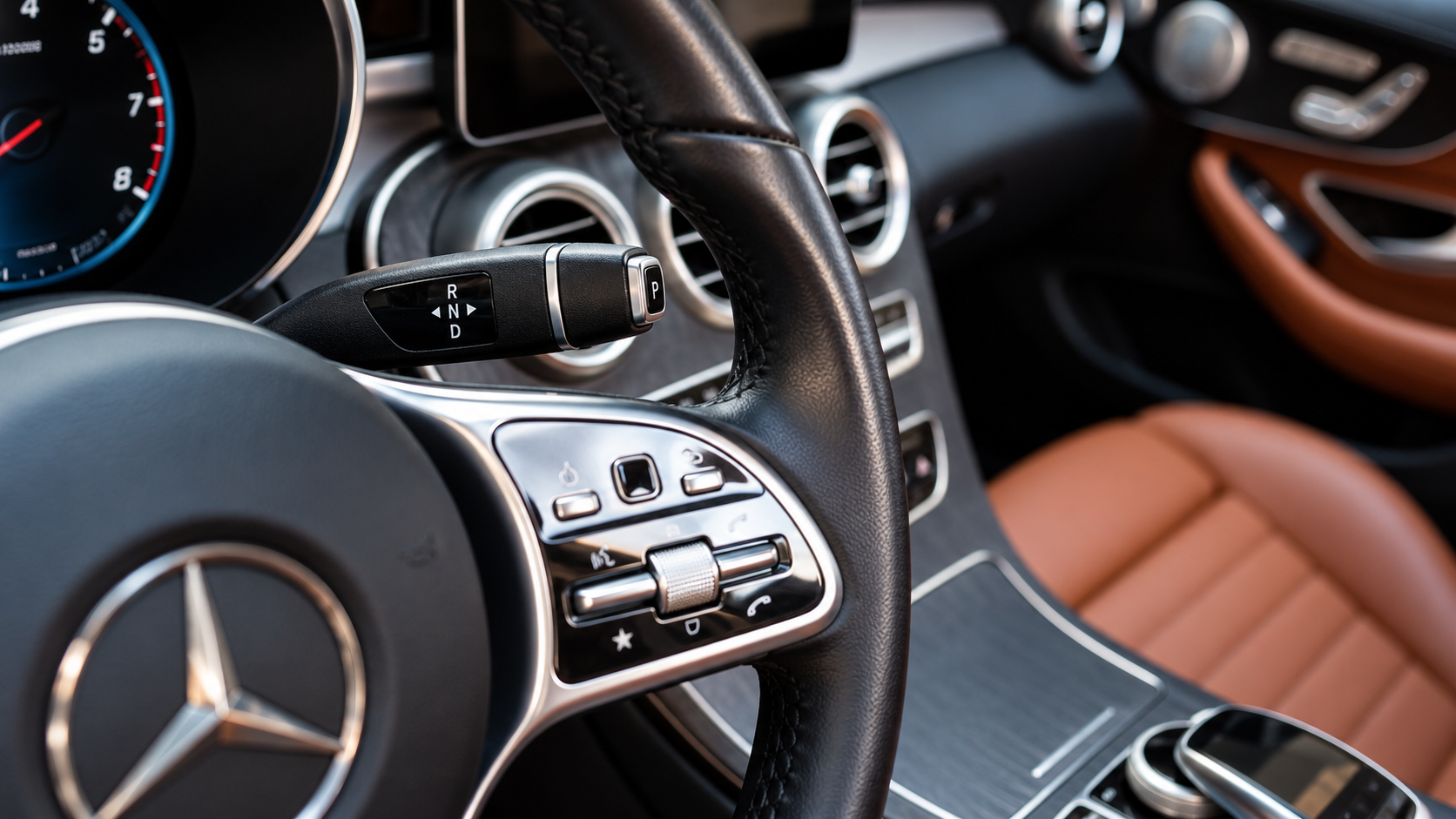
M (manual) mode allows you to select gears yourself. Typically, this is done by moving the gear selector toward the “+” or “-” signs, or by using steering-wheel-mounted paddles: the right paddle (“+”) shifts to a higher gear, while the left paddle (“-“) shifts to a lower one. Don’t worry about making a mistake – the transmission is protected against improper inputs; it will prevent the engine from reaching excessively high RPMs and will automatically downshift if your speed drops significantly.
In many vehicles, the steering-wheel-mounted paddle shifters also function while in D (Drive) mode. Pulling one of them causes the transmission to switch to manual mode temporarily, after which it reverts to automatic operation. This is useful when you need to quickly downshift before an overtake.
B, L, 2 and the drive mode button
B appears mostly in hybrids, such as many Toyota and Lexus models. It stands for engine braking. On a long downhill road, B slows the car without the brake pedal and charges the hybrid battery at the same time. On flat roads, just use D.
L, 1 or 2 keep the gearbox in the lowest gears. They are made for steep hills, both up and down. Going down a long mountain road in a low gear saves your brakes from overheating, which is much more important than it sounds.
Many cars also have a drive mode button or knob, separate from the gear lever. Eco makes the pedal softer and shifts up early to save fuel. Comfort or Normal is the everyday setting. Sport makes the pedal sharper, and in some cars it also firms up the steering and suspension. Large SUVs may offer Sand, Mud or Rock modes, but in a rental they are for a sandy parking area, not for dunes.
Finally, not all automatic transmissions function in the same way. A conventional automatic transmission shifts gears smoothly – often almost imperceptibly. A continuously variable transmission (CVT) – frequently found in Nissan and Toyota vehicles – has no fixed gear ratios at all, as a result, the engine sound may remain constant while the vehicle accelerates. A dual-clutch transmission, which is used in many sports cars, shifts gears very rapidly, though at low speeds, its operation can sometimes be felt as slight jerks.
Not every car has a lever
In newer cars, the classic gear lever is often replaced by something else. Mercedes-Benz puts a small stalk on the right side of the steering column: up for R, down for D, a button at the end for P. BMW and Porsche use a short joystick or toggle switch, and some Ford models use a round knob. Whatever the shape, the letters mean the same thing.
Many of these cars also switch to P by themselves when you turn off the engine or open the driver’s door. It is a good safety feature, but it surprises people at a conveyor car wash, where the car has to stay in N. Most cars have a special way to keep N with the engine off, so check the manual or ask before you drive in.
Common mistakes with an automatic
An automatic gearbox is easy to use, but it doesn’t like a few habits. These are the ones we see most often:
- Shifting from D to R, or from R to D, while the car is still rolling. Always stop completely first.
- Selecting P before the car has stopped, or relying on P alone on a steep slope without the handbrake.
- Putting the car in N at traffic lights or rolling downhill in N. You lose engine braking and control, and in most modern cars it doesn’t even save fuel.
- Driving with two feet, one on the gas and one on the brake. In an automatic, the left foot rests.
- Holding the car on a hill with the gas pedal instead of the brake. This overheats the gearbox, especially a dual-clutch one.
- Revving the engine in N and then dropping into D. It gives the gearbox a hard shock.
- Getting out of the car with the engine running and the lever in D. Thanks to creep, the car can slowly roll away.
Two more things worth knowing
Kickdown. When you press the gas pedal all the way to the floor, the gearbox drops one or two gears at once and gives you full power. This is how you overtake quickly in D, without touching S or the paddles.
Hill start assist. Most modern automatics hold the car for about two seconds after you release the brake on a slope. That gives you time to move your foot to the gas without rolling back. Some cars also have Auto Hold, which keeps the car still at any stop until you press the gas.
An automatic gearbox is designed to be simple, and in daily driving D is all you need. But knowing the other letters makes you a more confident driver, whether you are in a small city hatchback or a powerful sports car with paddles. And if you see an unfamiliar letter or button in one of our cars, just ask at pickup. We are always happy to explain.


