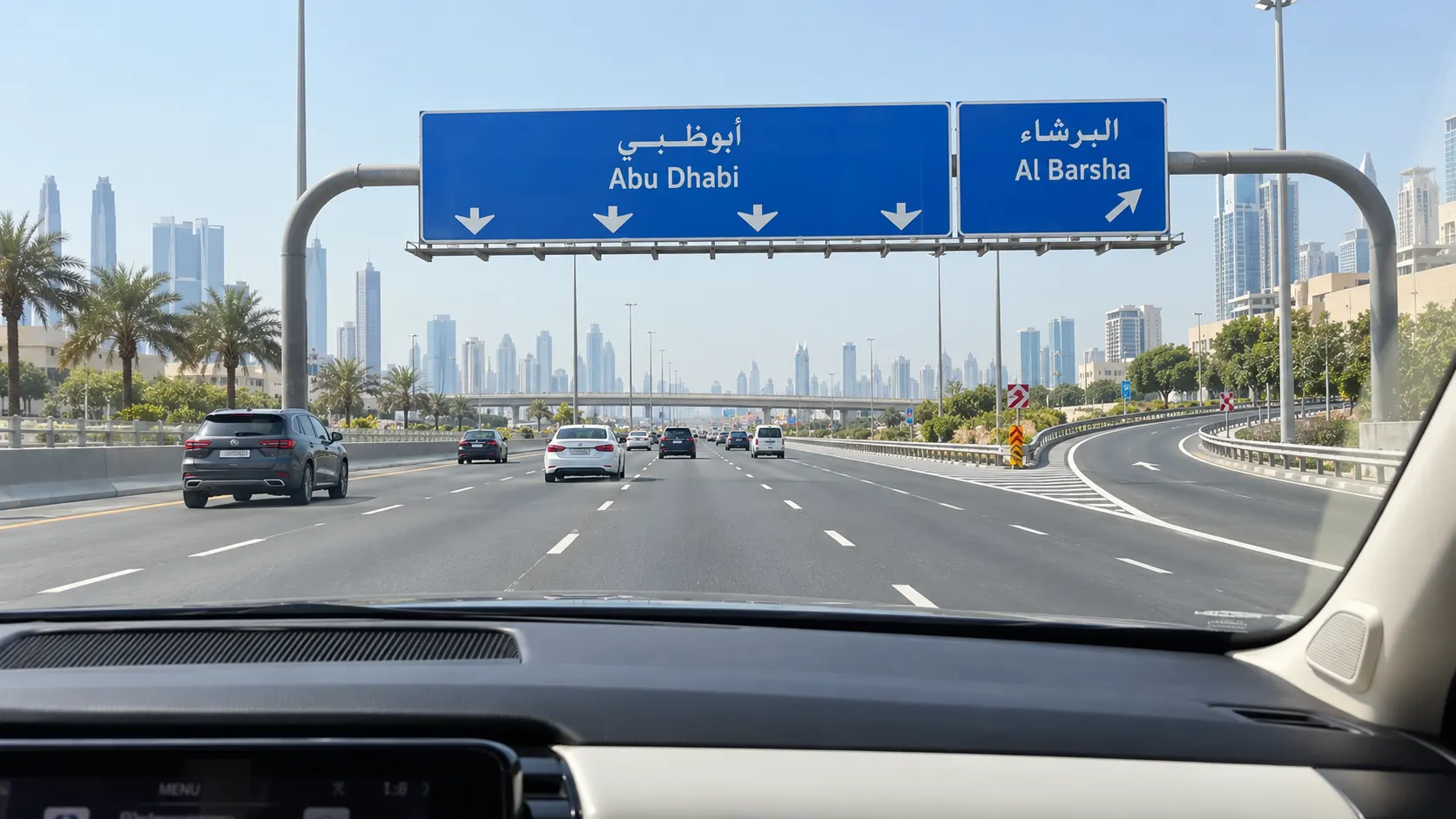
A car that suddenly stops on a Dubai highway is much rarer than a scratch in a car park, but it does happen, and usually at the worst moment. A tyre gives out on the way to the airport, or a red light appears on the dashboard while you're in the middle lane of Al Khail Road. Most of the time the car itself isn't badly hurt. The real risk is the next five minutes, when you're standing still on a road where everyone else is doing 100 km/h.
We've already written about what to do after a scratch or a collision. This article covers the other case: nobody hit anything, and the car simply can't, or shouldn't, go any further.
The first minute: get out of the traffic
If the car is still rolling, use that. Switch on the hazard lights, check your mirrors and ease over to the right, slowing down gradually instead of braking hard. Road Safety UAE puts the steps in exactly that order: hazards first, then a careful move to the right-hand hard shoulder, and if possible beyond it to somewhere safe.
Where you stop matters more than most people think. The best place is an exit, a petrol station or a car park, even if it means limping on for another kilometre. If you can't reach one, stop on the right-hand hard shoulder, as far from the lane as the space allows. The left shoulder next to the fast lane is the worst place to be, and stopping in prohibited areas there carries its own AED 1,000 fine.
The police take this seriously. Stopping in the middle of the road without good reason costs AED 1,000 and six black points, and Dubai Police once fined more than 11,000 drivers for it in a single year, mostly after breakdowns. The hard shoulder is meant for emergencies and patrols, so a breakdown counts, but a phone call, a photo or a quick look under the bonnet doesn't.
If your vehicle breaks down completely right on the roadway and cannot be moved, leave it where it is, turn on your hazard lights, and call 999. Police patrols will arrive at the scene to secure the vehicle and ensure the safety of the surrounding traffic environment.
Out of the car, and away from it
Shift the transmission into P (Park) and engage the parking brake. Ask everyone to exit the vehicle - if you have stopped on the right-hand shoulder, ensure they exit through the passenger-side doors so that no one ends up on the roadway. Then, move away from the car: if there is a safety barrier, stand behind it. It is better to move toward the front of the vehicle rather than toward the rear. Do not stand between your car and the flow of traffic, and do not remain inside the vehicle while waiting. Vehicles stopped on the shoulder are the most frequent targets for collisions caused by tired or inattentive drivers.
If there's a warning triangle in the boot and you can place it safely, Road Safety UAE recommends setting it at least 100 metres behind the car, on the same side of the road. Walk on the far side of the barrier while you do it, not along the edge of the lane. If placing it would mean walking along a fast road with no barrier, leave it and keep your distance from the car instead.
In summer the wait itself becomes a problem. Take water and your phone with you and find whatever shade there is, even the shadow of a sign gantry. Waiting in an air-conditioned car feels sensible, but on a highway shoulder it's one of the riskiest places you can be.
Who to call
Once everyone is off the road, call 999 if the car is blocking a lane, if anyone feels unwell, or if you couldn't get the car out of the traffic. For anything less urgent, Dubai Police have a non-emergency line, 901.
Be cautious of tow trucks that appear on their own. Sometimes, a tow truck driver might stop and offer to take your vehicle to an auto repair shop they "happen to know." If you are driving a rental car, please thank the driver but wait for the tow truck that we will dispatch. The vehicle must be brought specifically to our repair facility, otherwise - if the towing or repairs are arranged by an outside party - you risk incurring extra charges and running into unnecessary insurance complications.
A flat tyre
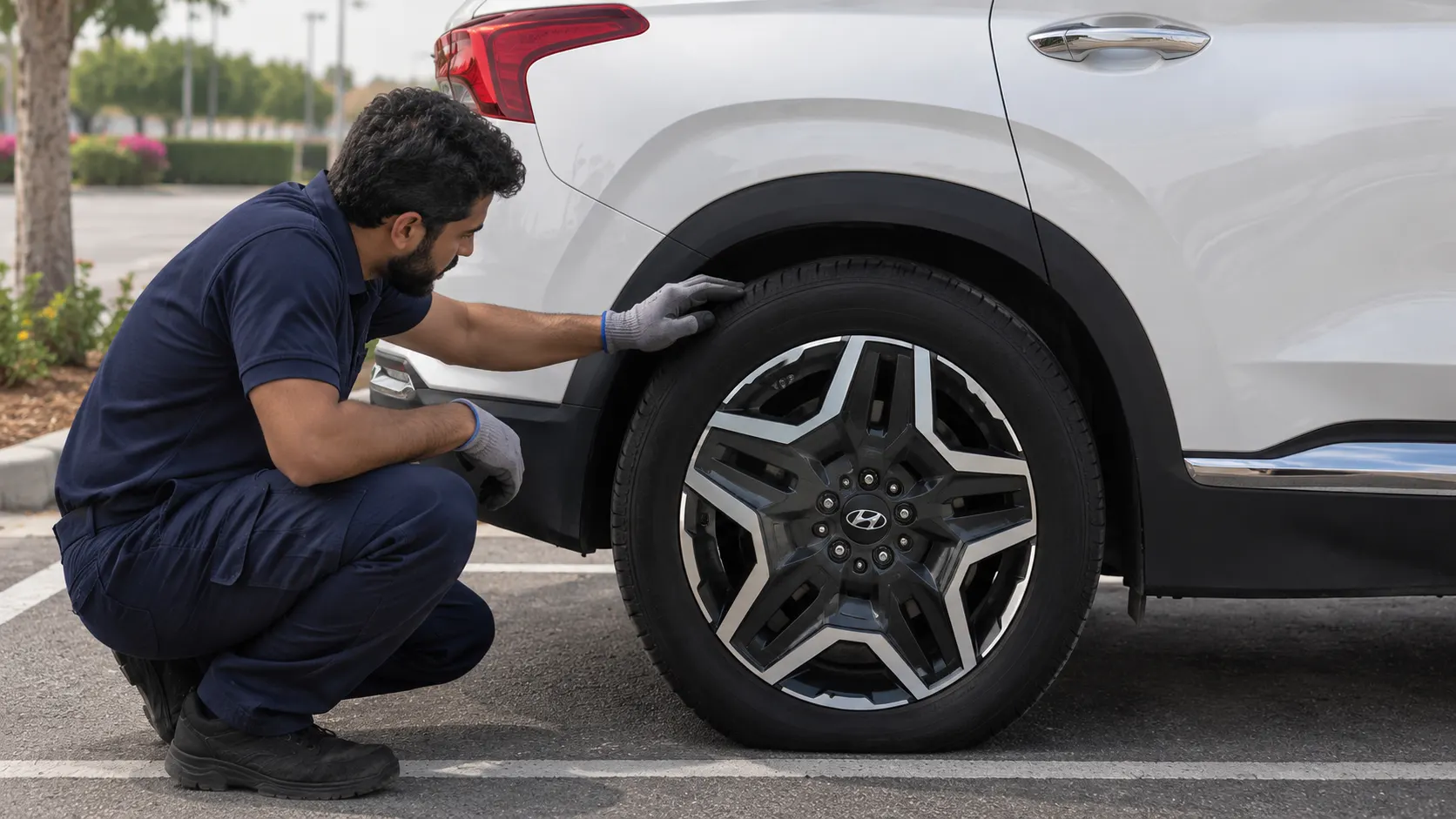
First, find out what kind of tyres the car has. Most BMW and Mini models, and many Mercedes saloons and SUVs, leave the factory on run-flat tyres and often carry no spare wheel at all. When a run-flat loses air, the tyre-pressure warning comes on but the car stays drivable. The usual rating is about 80 km at no more than 80 km/h, and Mercedes cuts that to around 30 km when the car is fully loaded. In Dubai that's normally enough to get off the highway and somewhere safe. Call us before you set off on it, and we'll tell you where to go.
Ordinary tyres are a different story. Once one goes flat, stop as soon as it's safe. Even a short drive on a flat destroys the tyre and can bend the rim, which turns a cheap puncture into an expensive wheel. Many newer cars have a can of sealant and a small compressor instead of a spare. That fixes a nail in the tread, but not a cut in the sidewall.
Changing a wheel on a highway shoulder isn't worth the risk. Trucks pass a metre away, and you're kneeling with your back to them. In a quiet car park, if you know how, go ahead. On the main road, wait for help.
Warning lights: red or amber
The color of the symbol tells you how urgent the problem is.
Amber or yellow means something needs attention soon, such as low tyre pressure or the engine management light. The car is usually fine to drive carefully to where you're going. Send us a photo of the dashboard and we'll tell you whether to carry on or bring it in.
Red means stop, as soon as you safely can. These are the ones worth knowing:
Temperature, a thermometer in waves. The engine is overheating. Pull over, switch off and let it cool. Don't open the coolant cap while the engine is hot, because the system is under pressure and the liquid can scald.
Oil pressure, a dripping oil can. Switch the engine off as soon as you've stopped. Driving on without oil pressure can wreck an engine in minutes.
Battery, a small battery symbol. The alternator has stopped charging and the car is running on what's left in the battery. Turn off the air conditioning and the radio and head for the nearest safe stop before it dies.
Brakes, an exclamation mark in a circle. If the handbrake is fully off and the light stays on, it can mean low brake fluid or a fault in the system. Slow down gently and stop.
Running out of fuel isn't a breakdown in the usual sense, but it ends the same way, on the shoulder with the hazards on. On longer drives, fill up when the gauge reaches a quarter rather than waiting for the warning light.
What happens next, and who pays
Once the car is collected, it goes to our workshop and the technicians find out what failed. If the cause is normal wear, like a battery at the end of its life or a part that simply gave up, that's the rental company's responsibility and not yours. While the car is being fixed, we can usually swap it for another one so the rest of your trip goes ahead.
It's different when the damage comes from how the car was driven. Hitting a kerb hard enough to split a tyre, driving on for twenty minutes after a red warning light, ploughing through deep water after a storm, or getting stuck in sand all fall under the insurance terms in your agreement, with the excess that comes with them.
This is why it helps to tell us early and exactly what happened: when the light came on and how far you drove after that. A quick photo of the dashboard at the moment the warning appeared can settle a lot of questions later.
Save the number before you need it
The most useful thing you can do takes ten seconds, and it's best done at pickup, not on a hard shoulder. Save our WhatsApp and emergency numbers in your phone when you collect the car. If it ever stops where it shouldn't, you'll be one message away from help instead of digging through the glovebox for the rental agreement with trucks going past.